Qwen3.8
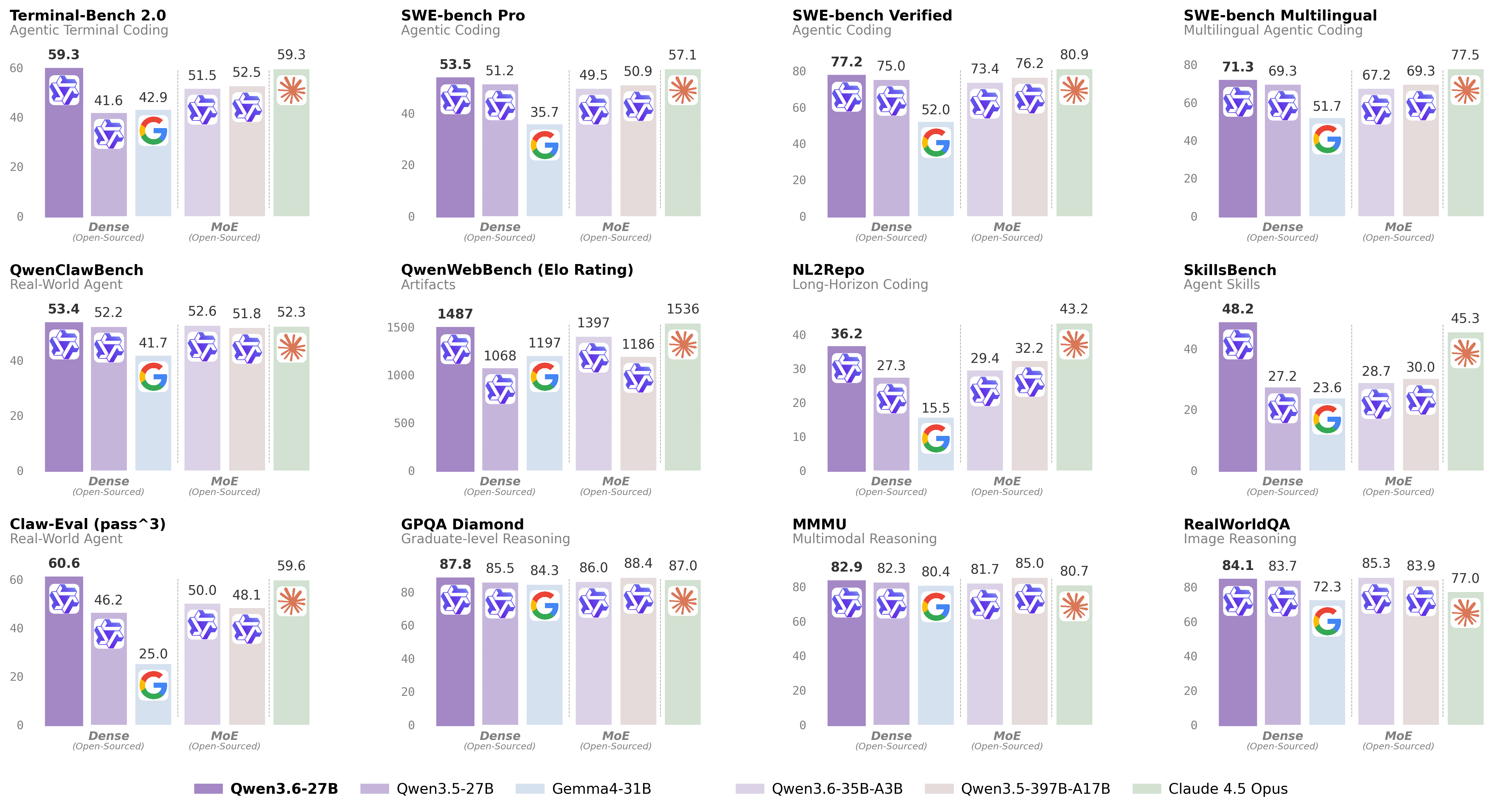
Qwen's 27B language model, run as ggml-org's Q4_K_M GGUF with llama.cpp. Qwen publishes FP8 and full weights, no GGUF.
Commercial use OK: code MIT, weights Apache-2.0. Measured on our RTX 4090: 43.0 tokens/s, first token in 204 ms, 18.3 GiB VRAM peak at 8K context. We scored it 81.0 on IFEval. GGUF weights, 17.67 GB.
License
Commercial use OK
- Code
- MITchecked 3 Nov 2026
- Weights
- Apache-2.0all sizes, checked 3 Nov 2026
Third-party quantization by ggml-org, at the pinned revision.
On our RTX 4090, measured
43.0tokens/s
Q4_K_M, batch 1, 512-token prompt, 256 tokens generated
- First token
- 204 ms
- Prompt reading
- 2514 tokens/s
- VRAM peak
- 18.3 GiB at 8K context
- GPU layers
- 65/65
Environment, 3 Nov 2026
NVIDIA GeForce RTX 4090, driver 580.173.02, llama.cpp v0.7.0 (b11669), CUDA 12.4. Baseline 801 MiB. 2 warm-up + 10 timed requests, median of 3 runs.
Accuracy
81.0IFEvalmeasured
IFEval, 541 items, Q4_K_M, lm-eval==0.4.13 · 3 Nov 2026
96.7GSM8Kmeasured
GSM8K, 8-shot chain of thought, 1,319 items, Q4_K_M, lm-eval==0.4.13 · 3 Nov 2026
Weights
Answers to the shared prompts
Same prompts for every model of this task, answered greedily with thinking off. Failures are marked by hand.
14 of 14 prompts answered, 2 marked as failures.
Instruction following
FAIL · Gradient checkpointing saves memory only in training, so the third way does nothing for inferenceThe prompt
List three practical ways to reduce GPU memory use when running a neural network for inference. Answer with exactly three bullet points, each under 15 words, and nothing else.
A correct answer: Exactly three bullet points, each under 15 words, with no text before or after them. Each way is real, such as lower precision, a smaller batch or a shorter input.
*   Use mixed precision inference with FP16 or BF16 formats.
*   Apply quantization to reduce model weights to 8-bit integers.
*   Enable gradient checkpointing to trade compute for memory savings.
Summarizing
FAIL · Doesn't say the conditions are written down before observing, and says the reference stars account for viewing quality, which the text doesn'tThe prompt
Summarize the paragraph below in exactly two sentences. A small observatory on a hill keeps a logbook for every night it opens. Before anyone looks through the telescope, they write down the cloud cover, the temperature and how steady the air is, because a blurry night and a sharp night can make the same star look very different. The staff also measure the same three reference stars at the start and end of each session. If those reference readings drift, every other number from that night is marked as uncertain rather than thrown away, so that later readers can decide for themselves how much to trust it.
A correct answer: Exactly two sentences. It mentions writing down the conditions before observing, and using reference stars to mark a night's numbers as uncertain. It adds nothing that the paragraph doesn't say.
The observatory records atmospheric conditions and measures reference stars at the beginning and end of each session to account for varying viewing quality. If the reference readings drift, the data is flagged as uncertain rather than discarded, allowing future researchers to evaluate its reliability.
Extracting data
The prompt
Extract these fields from the note below and answer with a JSON object only, without code fences: customer (string), date (YYYY-MM-DD), total_eur (number), items (array of strings). Note: Order for Mara Lindqvist, placed on 3 March 2026. She bought a desk lamp for 34.90 euros, two notebooks at 4.50 euros each, and a USB cable for 9.99 euros.
A correct answer: Valid JSON with exactly these keys and nothing around it: customer "Mara Lindqvist", date "2026-03-03", total_eur 53.89, and items naming the lamp, the notebooks and the cable.
{
  "customer": "Mara Lindqvist",
  "date": "2026-03-03",
  "total_eur": 53.89,
  "items": [
    "desk lamp",
    "notebooks",
    "USB cable"
  ]
}
Arithmetic
The prompt
A train leaves at 09:40 and travels 210 km at an average speed of 84 km/h. At what time does it arrive? Explain in at most three short steps, then give the final answer on its own line as "Answer: HH:MM".
A correct answer: The last line is "Answer: 12:10". The trip takes 210 / 84 = 2.5 hours.
1. Calculate the travel time by dividing the distance by the speed: $210 \text{ km} / 84 \text{ km/h} = 2.5 \text{ hours}$, which is 2 hours and 30 minutes.
2. Add the travel time to the departure time: 09:40 + 2 hours = 11:40.
3. Add the remaining 30 minutes: 11:40 + 30 minutes = 12:10.

Answer: 12:10
Logic
The prompt
Ana, Ben and Chloe each own exactly one pet: a cat, a dog or a parrot, and no two of them own the same pet. Ana does not own the dog. Chloe does not own the cat. Ben owns neither the cat nor the parrot. Who owns which pet? Answer in the form "Ana: ..., Ben: ..., Chloe: ...".
A correct answer: Ana: cat, Ben: dog, Chloe: parrot.
To determine who owns which pet, we can analyze the constraints step by step.

**The People:** Ana, Ben, Chloe
**The Pets:** Cat, Dog, Parrot

**Constraints:**
1. Ana does not own the dog.
2. Chloe does not own the cat.
3. Ben owns neither the cat nor the parrot.

**Step 1: Determine Ben's pet.**
From constraint 3, Ben does not own the cat and does not own the parrot. Since there are only three pets (cat, dog, parrot), Ben must own the remaining one.
*   **Ben owns the Dog.**

**Step 2: Determine Ana's pet.**
From constraint 1, Ana does not own the dog. Since Ben already owns the dog, this constraint is consistent but doesn't immediately solve it. However, we know the remaining pets are the Cat and the Parrot.
Let's look at Chloe first to see if it helps.

**Step 3: Determine Chloe's pet.**
From constraint 2, Chloe does not own the cat.
The remaining pets for Ana and Chloe are the Cat and the Parrot (since Ben has the Dog).
Since Chloe cannot own the Cat, she must own the Parrot.
*   **Chloe owns the Parrot.**

**Step 4: Determine Ana's pet.**
The only pet left is the Cat.
*   **Ana owns the Cat.**

**Verification:**
*   Ana owns the Cat. (Does not own the dog? Yes.)
*   Ben owns the Dog. (Owns neither cat nor parrot? Yes.)
*   Chloe owns the Parrot. (Does not own the cat? Yes.)
*   All pets are unique? Yes (Cat, Dog, Parrot).

**Final Answer:**
Ana: Cat, Ben: Dog, Chloe: Parrot
Writing code
The prompt
Write a Python function is_palindrome(s: str) -> bool that ignores case, spaces and punctuation. After the function, show two example calls with their expected results as comments.
A correct answer: A correct function: it keeps only letters and digits, lowercased, and compares them with their reverse. The examples are right, such as "A man, a plan, a canal: Panama" giving True.
```python
def is_palindrome(s: str) -> bool:
    """
    Check if a string is a palindrome, ignoring case, spaces, and punctuation.

    Args:
        s: The input string to check.

    Returns:
        True if the string is a palindrome, False otherwise.
    """
    # Filter out non-alphanumeric characters and convert to lowercase
    cleaned = ''.join(char.lower() for char in s if char.isalnum())
    # Check if the cleaned string is a palindrome
    return cleaned == cleaned[::-1]

# Example 1: "A man, a plan, a canal: Panama" is a palindrome
# is_palindrome("A man, a plan, a canal: Panama") -> True

# Example 2: "race a car" is not a palindrome
# is_palindrome("race a car") -> False
```
Fixing code
The prompt
This Python function should return the average of a list of numbers, but it gives wrong results. Explain the bug in one sentence, then give the corrected function. def average(values): total = 0 for i in range(1, len(values)): total += values[i] return total / len(values)
A correct answer: It says the loop skips the first number, because the range starts at 1. The fix sums every number, for example sum(values) / len(values). Handling an empty list is a bonus, not required.
The bug is that the loop starts at index 1 instead of 0, causing the first element of the list to be excluded from the sum.

```python
def average(values):
    total = 0
    for i in range(len(values)):
        total += values[i]
    return total / len(values)
```
Answering from a text
The prompt
Answer two questions using only the text below. If the text doesn't say, answer "Not stated." 1. What happens to a night's numbers when the reference readings drift? 2. In what year did the observatory open? Text: A small observatory on a hill keeps a logbook for every night it opens. Before anyone looks through the telescope, they write down the cloud cover, the temperature and how steady the air is, because a blurry night and a sharp night can make the same star look very different. The staff also measure the same three reference stars at the start and end of each session. If those reference readings drift, every other number from that night is marked as uncertain rather than thrown away, so that later readers can decide for themselves how much to trust it.
A correct answer: Question 1: they are marked as uncertain, not thrown away. Question 2: "Not stated." Any year it gives is invented, and a failure.
1. They are marked as uncertain rather than thrown away.
2. Not stated.
Translating
The prompt
Translate into Korean, polite and natural, as you would write to a colleague: "Thanks for sending the measurements. Could you run the larger model again tomorrow morning, when the machine is idle?"
A correct answer: Natural, polite Korean that keeps every part: thanks for the measurements, run the larger model again, tomorrow morning, when the machine is idle.
측정값을 보내주셔서 감사합니다. 내일 오전에 머신이 유휴 상태일 때, 더 큰 모델을 다시 실행해 주실 수 있을까요?
Rewriting
The prompt
Rewrite this message to be polite and clear, in under 60 words, keeping every fact: "your model page is wrong. the license says apache but the weights are non commercial. fix it"
A correct answer: Under 60 words and polite. It still says the page lists Apache while the weights are non-commercial, and asks for a correction.
Please review your model page. The license is listed as Apache, but the weights are restricted to non-commercial use. This discrepancy needs correction to ensure accuracy and compliance. Thank you for your prompt attention to this matter.
Classifying
The prompt
Label each review as positive, negative or mixed. Answer with a numbered list of labels only. 1. Setup took five minutes and it has worked perfectly ever since. 2. The battery died after two days and support never replied. 3. Great screen, but the speakers are tinny and quiet. 4. Honestly the best purchase I have made this year.
A correct answer: 1 positive, 2 negative, 3 mixed, 4 positive, and nothing else.
1. positive
2. negative
3. mixed
4. positive
Explaining
The prompt
Explain to a high-school student what VRAM is and why it limits which AI models can run on a graphics card. Use at most 80 words.
A correct answer: At most 80 words, and correct: VRAM is the graphics card's own memory, and a model's weights and working data must fit in it for the card to run the model.
VRAM is your graphics card’s dedicated memory, acting like a workspace for data. AI models are massive files that must fit entirely into this space to run. If a model is too big for your VRAM, it simply won’t load or will crash. This is why high-end cards with more VRAM can handle larger, smarter AI models, while smaller cards are limited to lighter, simpler versions. Think of it as trying to fit a giant book onto a tiny desk.
Command line
The prompt
Give one Linux shell command that lists the five largest files under the current directory, searching subdirectories too, with human-readable sizes. Answer with the command only.
A correct answer: One command that works, such as find . -type f -exec du -h {} + | sort -rh | head -n 5. A command that lists directories instead of files is a failure.
find . -type f -exec du -h {} + | sort -rh | head -n 5Knowledge
The prompt
In one sentence: what is the boiling point of water at sea level in degrees Fahrenheit, and who proposed the Fahrenheit scale?
A correct answer: 212 °F, and Daniel Gabriel Fahrenheit.
The boiling point of water at sea level is 212 degrees Fahrenheit, a scale proposed by Daniel Gabriel Fahrenheit.
Use it when
You want a large, commercially usable Qwen model that fits on one 24 GB card.
Avoid it when
You have a small card: the file alone is about 19 GB, and the smaller Qwen3.5 scored as well on instruction following and only a little lower on GSM8K math. This GGUF is ggml-org's quantization, not Qwen's own.
Sizes
| Size | Decode | VRAM | Accuracy | Weights | Runs | License |
|---|---|---|---|---|---|---|
| 27b-q4_k_m | 43.0 tok/s | 18.3 GiB | 81.0 IFEval, measured | 17.67 GB | As is | Commercial OK |